History of Croquet
Mallet and ball games are thought to have been first played in England and Europe during the middle ages. Games would normally involve only one ball which would be struck through very wide hoops. A Croquet-like game is believed to have been first played by thirteenth century French peasants who used crudely fashioned mallets to whack wooden balls through hoops made of willow branches. In seventeenth and eighteenth century France, mallet and ball games were quite popular and one of them, “Paille Maille”, was introduced to London where it was played in open ground near St. James’s Palace. This area became known as Pall Mall which is how the famous street of today got its name.
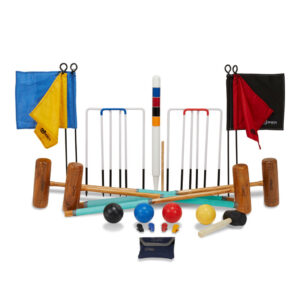
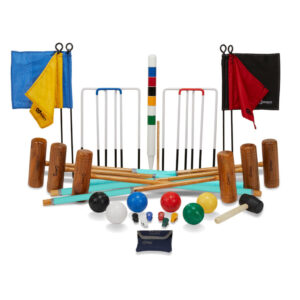
The modern game of Croquet appears to be Irish in origin. A game called Crooky was played in Ireland from the 1830’s and, in 1852, it was brought to England where it quickly became popular. It was particularly popular with women because it was the first outdoor sport which could be played by both sexes on an equal footing. Widespread popularity began when Croquet equipment became readily available due to London sporting goods manufacturer, John Jaques, who began selling complete croquet sets.
Over the next 30 years uniform rules were established and national competitions commenced, Croquet becoming a major sport of the day. The first national headquarters was the Wimbledon All England Croquet Club (later to become the Wimbledon All England Lawn Tennis and Croquet Club); the first national championships were held there in Victorian times.
Spearheaded by Australia and New Zealand, Croquet spread quickly to the British colonies. By 1870, croquet sets had reached virtually all of the British colonies and its popularity grew, following the earlier trend of being especially popular with women. Around this time, the game was denounced from the pulpits of the day, and play was actually banned at some sporting clubs. Croquet was played at the 1900 Olympics but around this time, the up-and-coming sport of Tennis started to eclipse Croquet and this other game’s ascension marked the end of Croquet’s heyday. The last 20 years has seen something of a resurgence particularly amongst the young.
Today, Croquet is played competitively in over twenty countries, the major ones in the 1990s being Australia, New Zealand, the United Kingdom and the USA and croquet sets are manufactured in many of these countries.
In the USA, two forms of the game are played, International Association croquet and American rules which uses the same lawn and equipment but has a few rule variations. Many of the best competitors play both versions. In addition there are some garden croquet sets which have 9 hoops and 2 pegs.
Many other countries play croquet or their versions of it. France hosted the 1995 World Croquet Federation Championships, Japan plays Croquet along with a similar game called Gateball, Egypt plays a simpler form of Association croquet. In Russia, Tolstoy apparently had a Croquet set for his lawn in his Moscow garden and astronauts are reported to have played for relaxation upon their return from space. Finally, China possesses many Croquet players from different age groups – a picture in the Illustrated London news of 1938 showed Revolutionary guards playing the game!
Learn more about Croquet from the Online Guide to Traditional Games.